|
|
|
|
1. Halimun-Salak National Park
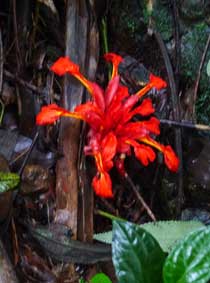
Vila Botani borders on the Haliman-Salak National Park (TNGHS in Indonesian).In 2003, the forested lands on Mt. Salak previously managed by the Forestry Department were merged with the former Halimun National Park. The TNGHS is the largest natural forest left in Java and contains hundreds of types of trees, in areas remote from its boundary. Near its boundary, however, it is comprised mainly of a few types of trees planted by the Forestry Department during reforestation projects dating back many decades. There are also hundreds of of kinds of wild animals in the park, including many birds, mammals, amphibians, repties and insects. Two rare species found here are the Javan Hawk-eagle (Spizaetusbartelsi), the Javan gibbon (Hylobatesmolochmoloch), and the Javan leopard (Panthera pardus). |
 |
Bordering on the northwest side of VB stands a mature pine forest planted in the EIghties by the Forestry Department and tapped for sap prior to its inclusion in the national park. Less than two kilometers above VB, at an altitude of about 900masl, stands a tropical rain forest that is dominated by puspa with some rasamala, also planted decades ago. This rain forest also also extends to the northwest of the tongue of pine forest beside VB and can be reached in only 30 minutes of walking at an altitude of about 800masl. At altitudes above 1000masl, the hiker begins to encounter a more mixed kind of native forest. The extensive forest is very suitable for trekking while protected from the tropical sun.
|
|
|
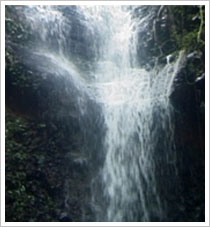
Cimuncang Creek flows down through the pine forest inside the National Park, just a few meters beside the VB boundary. Its clear waters flow over a fall (Curug) some 600m above VB. Unfortunately, during the dry season the creek tends to stop flowing, so that the fall is much reduced or even disappears altogether. The villagers say this happens because the creek flows through a pine forest, while the pine roots are said to absorb too much water which is then transpirated through the pine needles. Nevertheless, many streams at the foot of Mt Salak as well as Mt Pangrango and Gede are observed to go dry in the dry season, whether they flow through pine or rain forests. Furthermore, the many irrigation systems that drain water from springs in the forest and from tributaries of the Cimuncang surely play a role as they draw water away from the watershed. |
 |
3. Cipalasari Falls |
At the top of a former tea plantation that lies to the southeast of VB, about 4 km above VB, is found a large waterfall. It is much taller, more voluminous and more beautiful than the Cimuncang fall. On Sundays and holidays, many locals, mostly youth, visit the Cipalasari falls. The falls also provide fresh water for several kampongs. Another falls that is said to be even larger lies in the jungle about 3 km above Curug Cipalasari but is seldom visited due to the distance. |
4. Agriculture as locally practiced
|
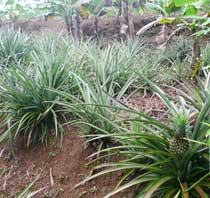
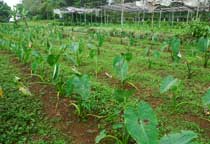
In the VB neighborhood are found several large blocks of land planted by villagers, most from nearby kampongs – Cijulang and Tapos in Sukaharja Village, and Tajur Halang Pojok in Tajur Halang Village. Mostly they plant pineapples, taro root, bananas, cassava, and some vegetables. Pineapple and taro are preferred because they grow well in acid soil (with a low pH), as is common on the slopes of Gn Salak. For pineapples, the farmers plant the Bogor variety, which is known as sweet with a relatively low water content. Several kinds of taro are planted.
Above and to the left of kampong Tajur Halang Pojok lies a wide and productive agricultural area of 45ha known as the former HGUarea, a former tea plantation taken over by the villagers in 2008. Besides the usual crops of pineapple, taro, banana and some vegetables, the farmers are also planting several kinds of trees for fruit and wood. Visitors who wander in this area may also wish to purchase pineapple or taro directly from the farmers. |

|
5. Cow milk |
Kampong Tajur Halang Pojok is known for its cows, whose milk is sold to the Bogor Milk Cooperative (KPS). The cows are owned by about 40 families, most of whom have only two or three cows, with the richest ones having seven or eight cows. A KPS truck collects the milk canisters at around 7-8 in the morning and again at around 3-4 in the afternoon. This is a good time for a visitor to buy a liter of milk from a villager at the going price of Rp 5-6,000 per liter. Some cow droppings are used to make biogas for cooking. Visitors can view the operation of the two biogas units in the kampong. Unfortunately, the bulk of the manure is still discarded, mostly endingup in a creek that flows down from the kampong. There is a clear potential for compost production.
|
|
Kampong Tajur Halang Pojok is known for its ornamental plants, sold by villagers from their front yards. During the height of the craze for anthurium trees, these plants were much in evidence in the kampong. Growers of the plants are also found in the other two nearby kampongs, Tapos and Cijulang. Unfortunately, the business declined sharply after 2008 in the wake of declining prices. Residents of Tajur Halang Pokok have shifted their focus to aquaculture – raising fish, especially carp, in simple tanks lined with plastic sheeting. This relies on a source of running fresh water, piped down in PVC pipes from Cipalasari falls. |
[Copyright ©by Alex Korns] |
|