|
Organic farm at Vila Botani
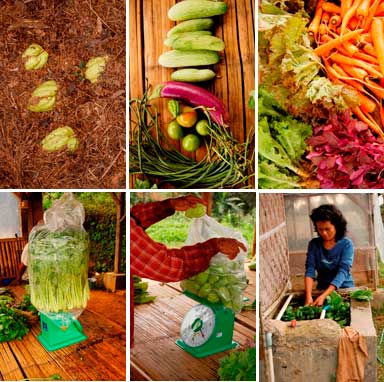
At VB, vegetables are harvested twice a week. Please contact Pk Jai (0888-1016075) if you would like to become a regular customer of VB vegetables or come to VB to see for yourself. In the absence of a wholesale market for organic vegetables, we plant small amounts of many kinds of vegetables, in many small installments which can be harvested once or twice a week.
|
|
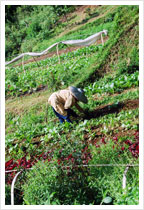
An organic farm at VB must address certain environ-mental issues. Soil on Mt. Salak, which has not erupted for many thousands of years, is very acid and less fertile than that on Mt. Gede and Pangrango. Typical pH readings for previously unfarmed VB soil that is still covered with grass and shrubs are 5.0, while readings for soil that was previously farmed with chemical fertilizers are around 4.5 – far below a neutral count of 7.0. The rain is very heavy during the rainy season, wind is strong on the ridgeline with the organic farm, and insect pests very active during the rainy season.
|
 |
|
|
To improve soil fertility, VB took the following steps:
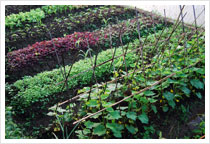
- Level the land into terraces and build raised beds in 8 x 1 meter size so that gains in soil fertility would not be washed away by rain.
- Apply crushed dolomite rock to raise pH to 5.5.
- Apply crushed phosphate rock to improve fertility.
- In many cases, plant wetland paddy (sawah) as the first crop, to raise the humus level.
- Apply generous amounts of compost to new beds, and add compost frequently, to further raise pH and improve fertility.
|
At this time (September 2010), there are about 180 standard beds (each 8 m long) for a total of only about 1400m of planted surface. Eventually, the planted area is expected to reach 400-500 beds.
Compost is made almost every day in the large compost shed, which previously housed chicken pens before the establishment of VB. Compost is made from a mix of the following ingredients:
-
Droppings from VB’s own goats and sheep.
-
Chicken droppings mixed with rice straw (sekam), purchased in the neighborhood.
-
Cut grass from VB. There is plenty of this, with grass growing in every nook and corner of VB.
-
Other fresh leaves from VB, especially ones that are known to decompose rapidly.
-
Stalks of nonproductive or dead banana trees, which are said to be effective in raising soil pH.
-
Urine from VB goats and sheep.
|
|
These ingredients are used as promptly as possible (while they still stink, or, in the case of the grass, while still green) so as to maximize nitrogen inputs. An indicator of high N levels is when the heap quickly gets very hot, due to the rapid proliferation of bacteria.
|
 |
Management of the crops is most difficult in the rainy season, when some crops cannot tolerate the humidity and pests, and in the dry season, when daily sprinklings may not suffice, even though water is relatively plentiful at VB. Management of the crops is easier in the transition periods from rainy to dry and back again.
|
| Marketing has been a challenge for VB. With time, VB has come increasingly to rely on direct sales to consumers as the quality of the product becomes more widely known. |
[Copyright ©by Alex Korns]
|
|