|
Arboretum
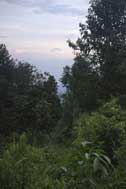
The Vila Botani arboretum is not yet much to look at, but will become far more interesting in the next 5-10 years. Half the Vila Botani land area is dedicated to this collection of trees, which are being planted at intervals of about 4 meters. About 1400 trees will be planted, of which about 1100 are now in place, representing over 100 different species, mostly local ones. As the trees get bigger, Vila Botani staff will also plant typical bushes underneath, so that the arboretum will resemble a tropical jungle when the trees reach full size.
|
|
The original idea was to try to imitate what an original jungle may have once looked like in Awas Paninggal. Studies of tropical forests have typically shown a great variety of species – as many as 200 species per hectare. This is a far cry from the forests that we usually observe when hiking, where a single species predominates because the forest was recently replanted by man, usually by the government. To observe a true variegated forest, we must walk for many hours from the nearest kampong to find ancient or “virgin” forests that have never been cut.
|
 |
Although our trees have been planted in a mostly random way, certain patterns do hold. The largest trees, expected to reach heights well above 30m, are planted at intervals of 8 to 9 meters, while the lesser trees are planted in between. Rasamala and puspa are among the tallest trees being planted, but these mainstays of reforestation together account for less than 10 percent of the plantings. Certain collections have been grouped in certain areas. Various tropical oaks have been gathered together in the “Kebun Pasang” toward the upper end of Vila Botani. These trees with very large seeds (like acorns or chestnuts) have been particularly difficult to collect. They have very sensitive root structures and do not take kindly to transplanting, so that it has been necessary to collect tiny specimens, typically 10-20cm high. A smaller group, also planted toward the upper end of Vila Botani, includes representatives of the dipterocarp family, most of which have a sap that can be tapped and sold as resin or gum. These trees are grouped in the “Kebun Dammar”, named after the sap -- which is also known as “dammar”. Another large group of trees, planted at the lower end of Vila Botani, is called the “Kebun Huru”, named for various species among the Lauraceae family
|
Most of the trees in the arboretum are indigenous from West Java, although a few originate from elsewhere in Indonesia or even, as in the case of the magnolia or cempaka, from outside Indonesia. Most of the local trees are from the sub-montane groups, which typically flourish between 600 and 1500masl, while some are from the lowland groups and a few are from the montane groups, which flourish above 1500masl. For example, the collection includes the following families:
- Euphorbiaceae, the spurge family of rubber trees, of which 18 types are being planted.
- Lauraceae, or laurel family, of which 16 types are being planted, including many types in the Kebun Huru.
- Fagaceae, or tropical oaks, of which 10 types are being planted, mostly in the Kebun Pasang.
- Moraceae, or mulberry/fig family, of which 9 types are being planted.
- Myrtaceae, or myrtle family, of which 8 types are being planted.
|
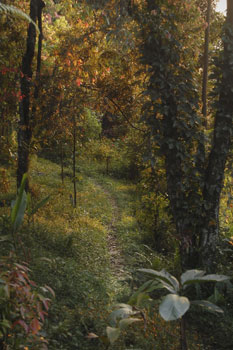 |
As each tree is planted, a small terrace is dug out around it, to promote absorption of water during the dry season. The trees are watered once or twice a week during the dry season to minimize mortality. Losses have been quite low, only about 10-15 percent of the trees planted, except that certain species have been found unsuitable for Vila Botani soil; for these, mortality has been high. This includes jabon and calik angin. A full list of the species planted will be posted next year, when planting is nearly finished.
|
|
| [Copyright ©by Alex Korns] |
|